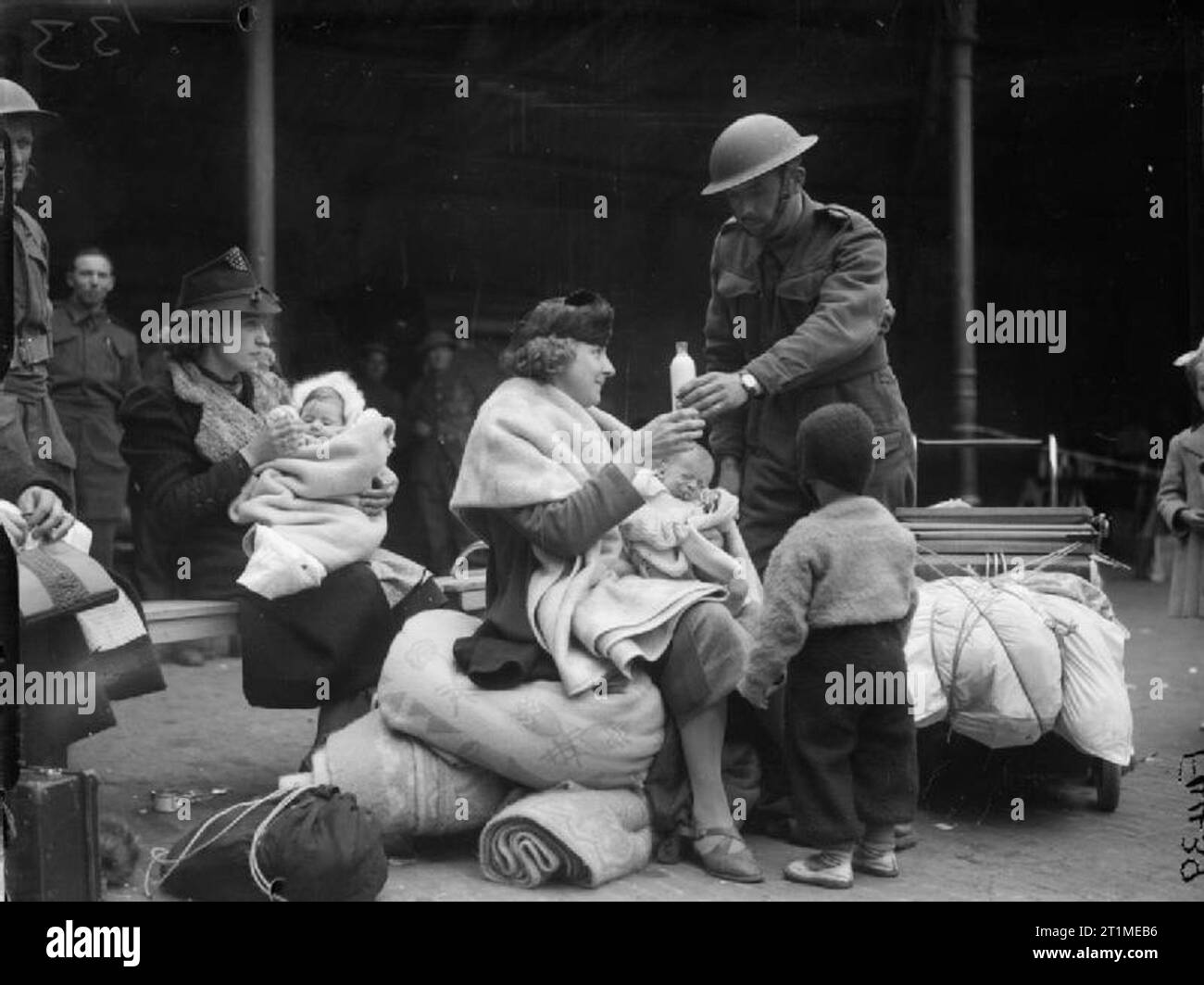
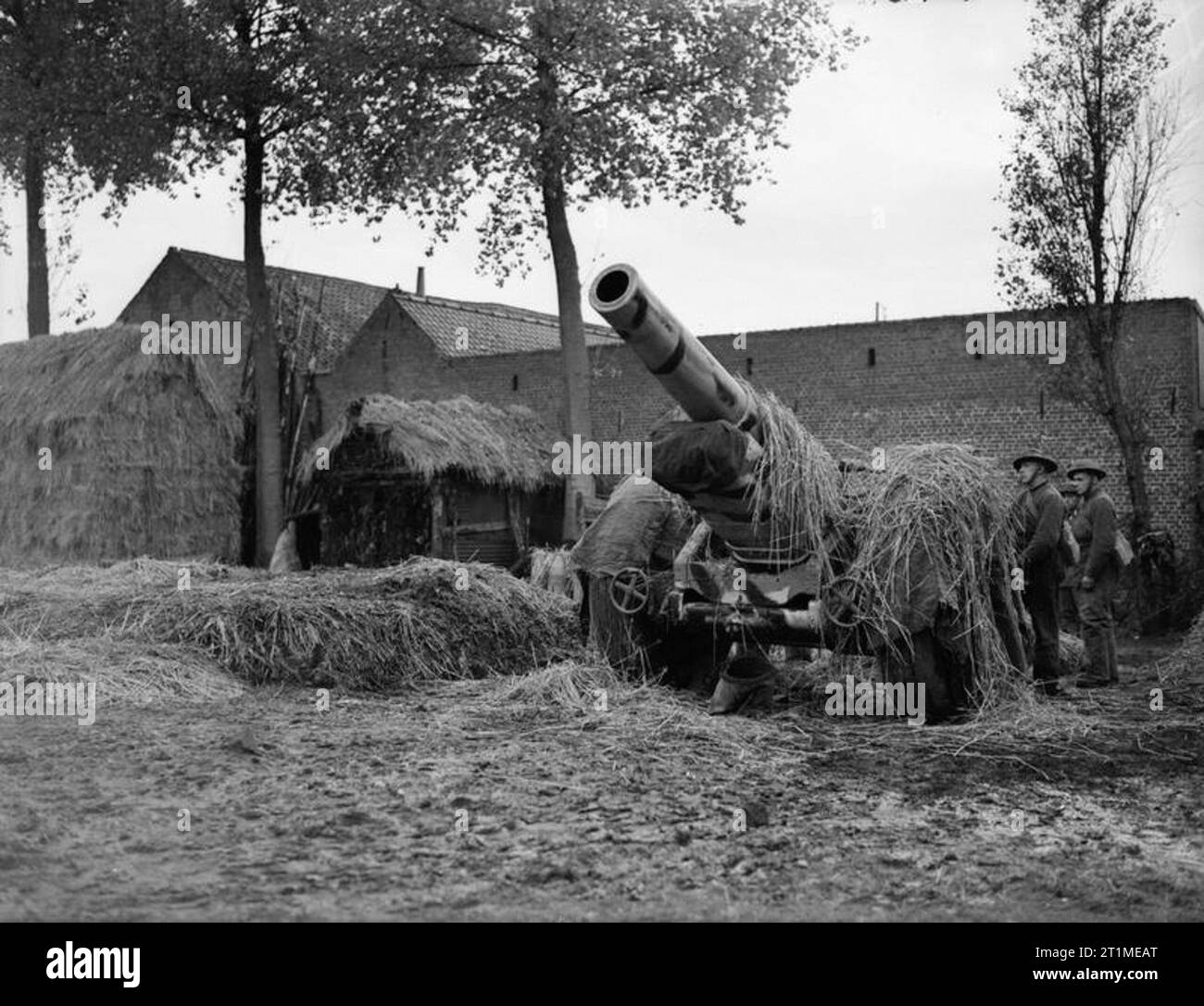
This is the British Expeditionary Force order of battle on 9 May 1940, the day before the German forces initiated the Battle of France.
High-level order of battle
First Expeditionary Force
- General John Vereker, 6th Viscount Gort
- 5th Infantry Division (Major-General Harold Franklyn)
- I Corps (Lieutenant-General Michael Barker)
- 1st Infantry Division (Major-General Harold Rupert Leofric George Alexander)
- 2nd Infantry Division (Major-General Henry Charles Loyd)
- 48th (South Midland) Infantry Division (Major-General Augustus Francis Andrew Nicol Thorne)
- II Corps (Lieutenant-General Alan Brooke)
- 3rd Infantry Division (Major-General Bernard Montgomery)
- 4th Infantry Division (Major-General Dudley Johnson)
- 50th (Northumbrian) Motor Infantry Division (Major-General Giffard Martel)
- III Corps (Lieutenant-General Sir Ronald Forbes Adam
- 42nd (East Lancashire) Infantry Division (Major-General William Holmes)
- 44th (Home Counties) Infantry Division (Major-General Edmund Osborne)
- Saar Force (Major-General Victor Fortune)
- 51st (Highland) Infantry Division (Major-General V. M. Fortune)
- Formations undergoing training and performing labour duties
- HQ Lines of Communication British Expeditionary Force (Major-General Philip de Fonblanque)
- Units arriving in France after 10 May 1940
Other formations
- Air Component
- Second Expeditionary Force
First Expeditionary Force
General Headquarters (GHQ)
- General Officer Commanding-in-Chief: General John Vereker, 6th Viscount Gort
- Chief of the General Staff: Lieutenant-General Sir Henry Royds Pownall
- Adjutant General: Lieutenant-General Sir W. D. S. Brownrigg
- Quartermaster General: Lieutenant-General W. G. Lindsell
- Deputy Chief of the General Staff; Major-General Philip Neame
- Major-General Royal Artillery: Major-General Sydney Rigby Wason
- Engineer-in-Chief: Major-General Ridley Pakenham-Walsh
GHQ, BEF Headquarters Troops
Armoured Brigades
- 1st Light Armoured Reconnaissance Brigade
- Brigade manning armoured cars
- 1st Light Armoured Reconnaissance Brigade Headquarters and Signals Section, Royal Signals
- 1st Fife and Forfar Yeomanry
- 1st East Riding of Yorkshire Lancers
- Brigade manning armoured cars
- 2nd Light Armoured Reconnaissance Brigade
- Brigade manning armoured cars
- 2nd Light Armoured Reconnaissance Brigade Headquarters and Signals Section, Royal Signals
- 5th (Royal Inniskilling) Dragoon Guards
- 15th/19th (The King's) Royal Hussars
- Brigade manning armoured cars
- 1st Army Tank Brigade
- Brigade manning infantry and cavalry tank
- 1st Army Tank Brigade Headquarters and Signals Section, Royal Signals
- 4th Royal Tank Regiment
- 7th Royal Tank Regiment
- Brigade manning infantry and cavalry tank
Commander Royal Artillery
Commander Royal Engineers
Major-General Ridley Pakenham Pakenham-Walsh
- Direct reports
- 100th (Monmouthshire) Army Field Company, Royal Monmouthshire Royal Engineers
- 101st (Monmouthshire) Army Field Company, Royal Monmouthshire Royal Engineers
- 216th (1st London) Army Field Company, Royal Engineers
- 228th (West Riding) Field Company, Royal Engineers
- 242nd (Lowland) Field Company, Royal Engineers
- 223rd (2nd London) Field Park Company, Royal Engineers
- 109th Workshop and Park Company, Royal Engineers
- 1st Army Troops Company, Royal Engineers
- 2nd Army Troops Company, Royal Engineers
- 19th Army Field Survey Company, Royal Engineers
- 119th Road Construction Company, Royal Engineers
- 135th Excavator Company, Royal Engineers
- 1st Boring Section, Royal Engineers
- 2nd Boring Section, Royal Engineers
- 1st Anti-Gas Laboratory, Royal Engineers
- 58th (Chemical Warfare) Company, Royal Engineers
- 61st (Chemical Warfare) Company, Royal Engineers
- 62nd (Chemical Warfare) Company, Royal Engineers
- 1st Tunnelling Group, Royal Engineers
- 170th Tunnelling Company, Royal Engineers
- 171st Tunnelling Company, Royal Engineers
- 172nd Tunnelling Company, Royal Engineers
- 173rd Tunnelling Company, Royal Engineers
5th Infantry Division
Major-General Harold Franklyn [nb 1] [nb 1] [nb 1] [nb 1] [nb 1] [nb 1]
I Corps
Lieutenant-General Michael Barker
1st Infantry Division
Major-General Harold Rupert Leofric George Alexander
2nd Infantry Division
Major-General Henry Charles Loyd
48th (South Midland) Infantry Division
Major-General Augustus Francis Andrew Nicol Thorne
II Corps
Lieutenant-General Alan Brooke
3rd Infantry Division
Major-General Bernard Montgomery
4th Infantry Division
Major-General Dudley Johnson
50th (Northumbrian) Motor Infantry Division
Major-General Giffard Martel
III Corps
Lieutenant-General Sir Ronald Forbes Adam
42nd (East Lancashire) Infantry Division
Major-General William Holmes
44th (Home Counties) Infantry Division
Major-General Edmund Osborne
Saar Force
Major-General Victor Fortune
On 10 May 1940, this force, which was really just the 51st Division reinforced by various small units, was part of the Colonial Army Corps of the French Third Army in front of the Maginot Line.
Units attached to the 51st (Highland) Infantry Division in April 1940 to form Saar Force
- Lothians and Border Horse
- 7th Battalion The Northumberland Fusiliers (Machine-Guns)
- 1st Battalion Princess Louise's Kensington Regiment (Machine-Guns)
- 7th Battalion The Royal Norfolk Regiment (Pioneers)
- 6th Battalion The Royal Scots Fusiliers (Pioneers)
- Sound Ranging and Survey Troop - detached from 3rd Survey Regiment RA
- 1st Regiment Royal Horse Artillery (Field)
- 51st (Midland) Medium Regiment Royal Artillery
- 385/97 Army Field Battery Royal Artillery
- 213th (North Midland) Army Field Company Royal Engineers
- Topographic Section from 19th Army Field Survey Company Royal Engineers
- 22nd Animal Transportation Company Royal Indian Army Service Corps
- Sub-Division from III Corps Ammunition Park Royal Army Service Corps
- F Section from III Corps Petrol Park Royal Army Service Corps
- 10th Army Field Workshop Royal Army Ordnance Corps
- 10th Salvage Unit
51st (Highland) Infantry Division
Major-General V. M. Fortune
Formations undergoing training and performing labour duties
12th (Eastern) Infantry Division
Major-General R. L. Petre
23rd (Northumbrian) Division
Major-General W. N. Herbert
46th Infantry Division
Major-General H. O. Curtis
HQ Lines of Communication British Expeditionary Force
Major-General Philip de Fonblanque
Units arriving in France after 10 May 1940
1st Armoured Division
Major-General R. Evans
Air component
- Air Vice-Marshal Charles Blount (Data from Jackson 1974 unless indicated.)
- 85 Squadron: Hurricane (fighter)
- 87 Squadron: Hurricane (fighter)
- 607 Squadron: Gladiator (fighter, converting to Hurricane May 1940)
- 615 Squadron: Gladiator (fighter, converting to Hurricane May 1940)
- 3 Squadron: Hurricane (fighter; reinforcement, May 1940)
- 79 Squadron: Hurricane (fighter; reinforcement, May 1940)
- 504 Squadron: Hurricane (fighter; reinforcement, May 1940)
- From 22 (Army Co-operation) Group
- 81 Squadron: Blenheim I (strategic reconnaissance)
- 57 Squadron: Blenheim I (strategic reconnaissance)
- 53 Squadron: Blenheim IV (bomber)
- 59 Squadron: Blenheim IV (bomber)
- 2 Squadron: Lysander (army co-operation)
- 4 Squadron: Lysander (army co-operation)
- 13 Squadron: Lysander (army co-operation)
- 16 Squadron: Lysander (army co-operation)
- 26 Squadron: Lysander (army co-operation)
Second Expeditionary Force
The following force was sent to France during the second week of June 1940 in an unsuccessful attempt to form a second British Expeditionary Force. This second formation was to be commanded by Lieutenant-General A. F. Brooke. All units were evacuated in late June 1940, during Operation Aerial.
- 1st Canadian Infantry Brigade (from 1st Canadian Infantry Division)
- Royal Canadian Regiment
- Hastings and Prince Edward Regiment
- 48th Highlanders of Canada
- 1st Field Regiment Royal Canadian Horse Artillery
52nd (Lowland) Infantry Division
Major-General J. S. Drew
See also
- Order of battle for the Battle of France
- List of British Empire divisions in the Second World War
Notes
Footnotes
References
- Baughen, G. (2016). The RAF in the Battle of France and the Battle of Britain: A Reappraisal of Army and Air Policy 1938–1940. Stroud: Fonthill Media. ISBN 978-1-78155-525-5.
- Ellis, Major L. F. (2004) [1953]. Butler, J. R. M. (ed.). The War in France and Flanders 1939–1940. History of the Second World War United Kingdom Military Series (repr. Naval & Military Press, Uckfield ed.). HMSO. ISBN 978-1-84574-056-6. Retrieved 21 October 2016.
- Jackson, R. (1974). Air War over France 1939–40 (1st ed.). London: Ian Allan. ISBN 978-0-7110-0510-5.
External links
- "Documents – France & Norway 1940". British Military History. Retrieved 2019-10-27.
- "British Expeditionary Force, May 1940". niehorster.org. Retrieved 2019-10-26.
- "British Infantry Brigades, 1st thru 215th - 1939-1945" (PDF). web.archive.org. 2016-03-03. Retrieved 2019-10-29.