Muzaffargarh District (Urdu: ضِلع مُظفّرگڑھ) is a district of the Punjab province of Pakistan. Its capital is Muzaffargarh city. It lies on the bank of the Chenab River.
History
Muzaffargarh (lit. 'Fort of Muzaffar') was founded by the Saddozai Nawab of Multan, Nawab Muzaffar Khan, in 1794. Muzaffargarh district was annexed by the British from its former Sikh rulers after the Second Anglo-Sikh War of 1848–1849. In 1861 it became the separate Muzaffargarh District. After the independence of Pakistan in 1947, the minority Hindus and Sikhs migrated to India while the Muslim refugees from India settled in the Muzaffargarh District. Muslim refugees from East Punjab, Haryana, Jammu started arriving and crossed the border into Pakistan; many were given land in Muzaffargarh District to settle.
Administration
The district is administratively divided into the following three tehsils (subdivisions), which contain a total of 93 Union Councils:
Demographics
Population
As of the 2023 census, present Muzaffargarh district has 552,926 households and a population of 3,528,567. The district has a sex ratio of 104.18 males to 100 females and a literacy rate of 43.74%: 51.38% for males and 35.74% for females. 1,185,064 (33.60% of the surveyed population) are under 10 years of age. 662,975 (18.79%) live in urban areas.
Religion
Language
At the time of the 2023 census, 93.40% of the population spoke Saraiki, 3.65% Urdu and 2.50% Punjabi as their first language.
Ethnicity
The most famous tribes and races are as under; Khar (offshoot of Kharal tribe), Khokhar, Dasti, Qureshi, Jatoi, Hinjra, Langrial, Thahim, Gopang, Bukhari, Gilani, Rajput, Jat and Arain. The major ethnic group are the Saraiki-speaking Jat forming the majority, with Saraiki-speaking Gujjar, Baloch, Rajputs and Pathan groups in minority.
Geography and climate
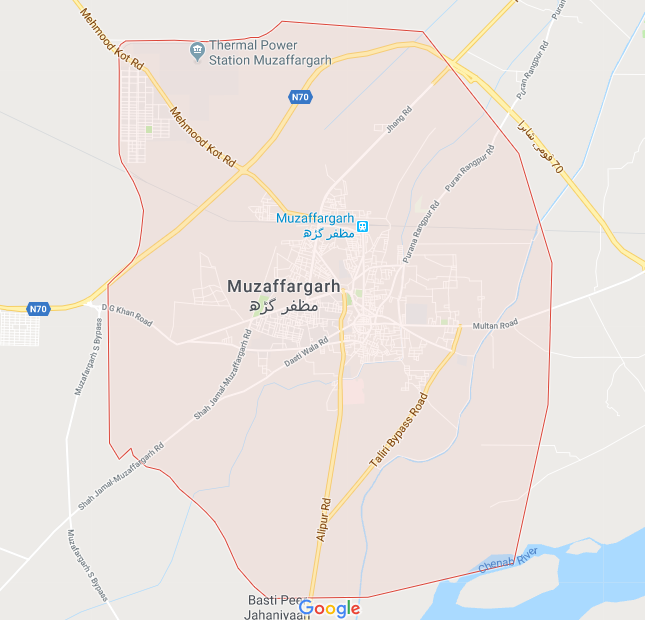
Muzaffargarh spreads over an area of 8,249 km2 and forms a strip between the Chenab River on its east and Indus River on its west, which pass along the Eastern and Western boundaries respectively of the district and a triangle at Alipur tehsil of the district. The district is bounded on the north by district Layyah, on the south by Bahawalpur and Rahimyar Khan districts across the river Chenab.
Districts Multan and Khanewal are on the eastern side of district Muzaffargarh, across the river Chenab. District Jhang touches it on the northeast. Dera Gahzi Khan and Rajanpur districts lie on the western side across the river Indus. It is one of oldest districts of Punjab. According to the 1998 census of Pakistan, the population of the district was 2,635,903, of which 12.75% were urban. Muzaffargarh is one of oldest districts of Punjab.
2010 floods
Muzaffargarh was especially hard hit by the 2010 Pakistan floods, given its position between the Chenab and Indus rivers It is spread over an area of 8,249 km2. Muzaffargarh District lies in the strip between the rivers Chenab and Indus.
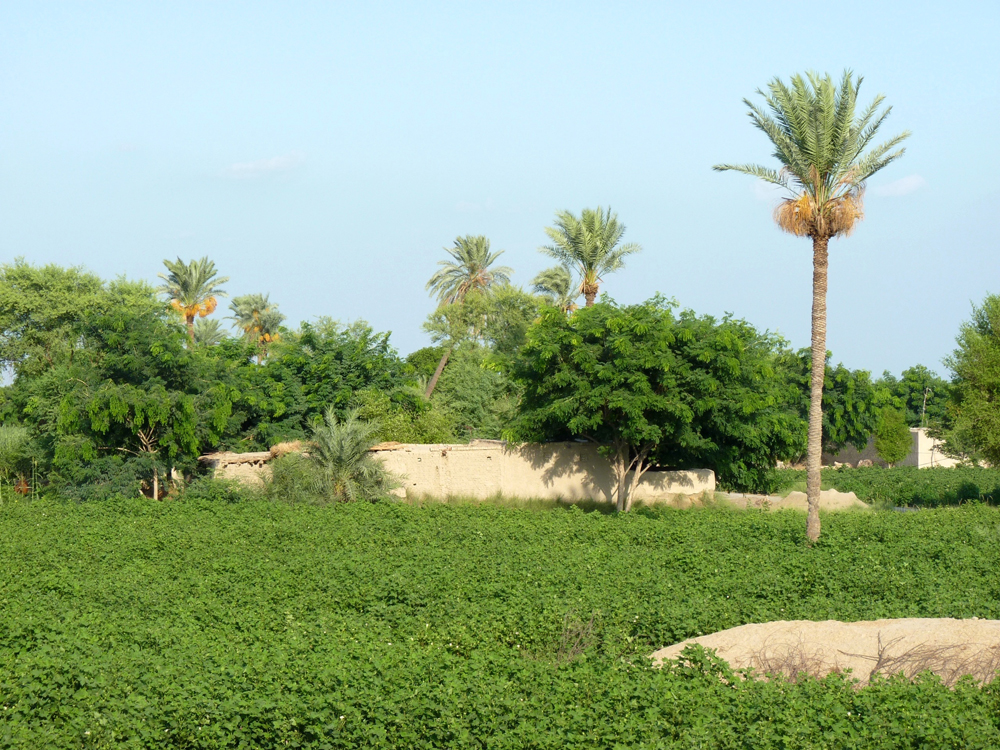
The city of Muzaffargarh is located in southern Punjab province at almost the exact centre of Pakistan. The closest major city is Multan. The area around the city is a flat, alluvial plain and is ideal for agriculture, with many citrus and mango farms. There are many canals that cut across the Muzaffargarh District providing water from nearby farms. This makes the land very fertile. However usually land close to the Chenab are usually flooded in the monsoon season.
Climate
Muzaffargarh features a semi arid climate with very hot summers and mild winters. The city witnesses some of the most extreme weather in the country. The highest recorded temperature is approximately 54 °C (129 °F), and the lowest recorded temperature is approximately −1 °C (30 °F). The average rainfall is roughly 427 millimetres (16.8 in). Dust storms are a common occurrence within the city.
The district's towns include Basti Malik Wala, Taliri, Mauza Bahadur Dawana, Dawana Bahadur Peer Rajan Bukhsh, Kot Addu, Khangarh and Hayat Nagar.
Education
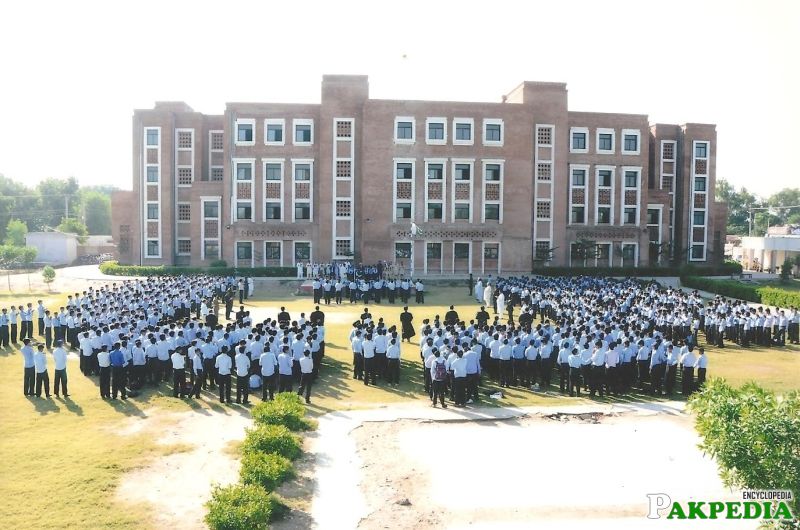
Although Muzaffargarh is one of the oldest and largest districts of Pakistan by area and population, it still has only a single campus of Virtual University of Pakistan. The literacy rate is one of the lowest in the country. District Muzaffargarh has a total of 1,072 male and 1,009 female public sector schools. According to the School Education Department's data, a total of 5,023 male and 4,130 female teachers are employed in public school education sector of the district.
Forests
An area of 100,864 acres is forested in the district biggest Lashari wala Forest. There is also linear plantation of 1250 A.V. mile the roads/rails/canals in the district. Trees grown in the area are kikar, shisham, millbury, eucalyptus, bamboo and coconut.
Notable people
- Milkha Singh, a famous track and field athlete
Notes
References
External links
Media related to Muzaffargarh District at Wikimedia Commons